The complete guide
Tarrytown, Austin
The quiet, oak-shaded address on the west side of Austin where established wealth, Lake Austin frontage, and one of the best public schools in Texas have held their value through every cycle since 1934.
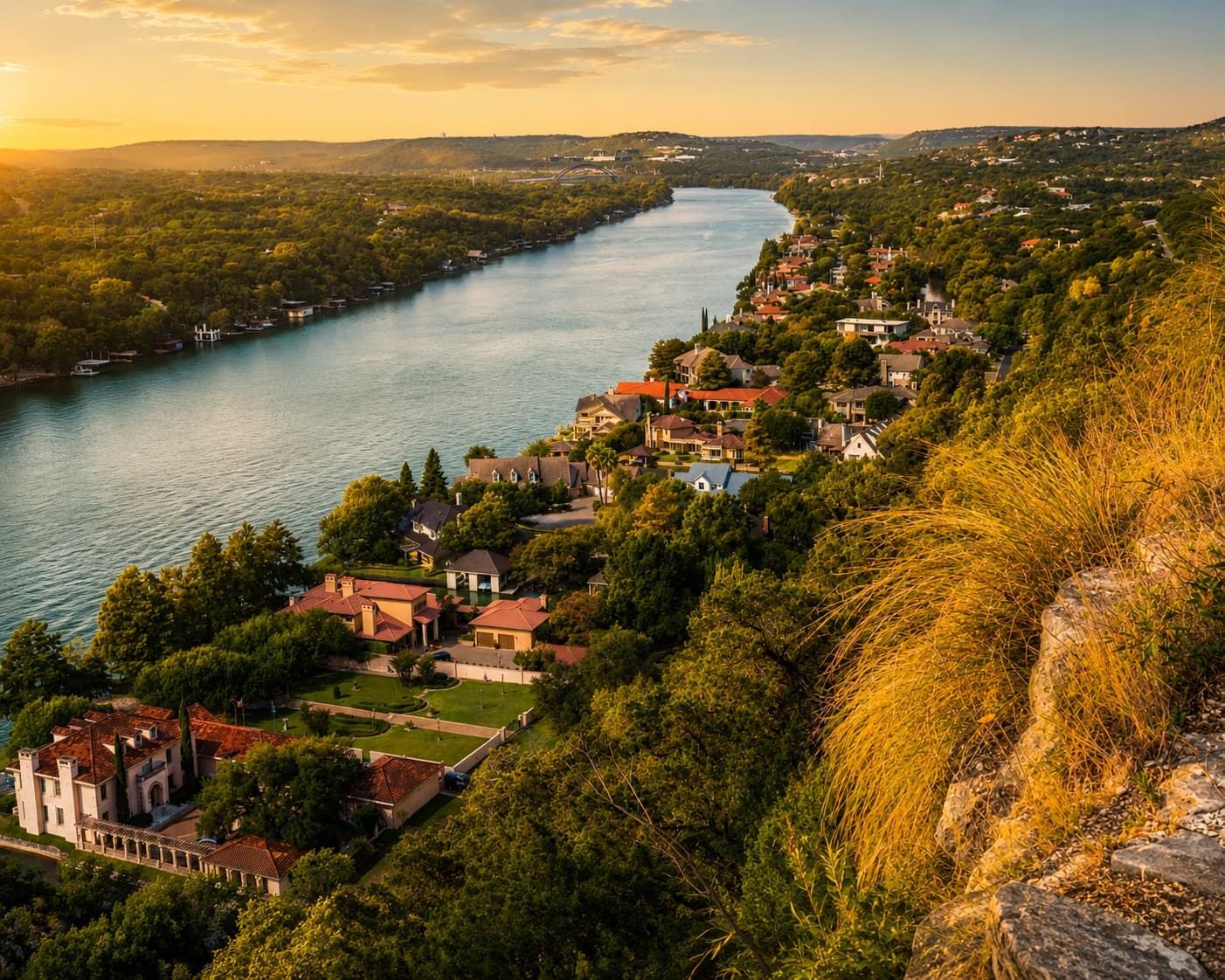
Tarrytown is a residential neighborhood in West Austin, Texas, ZIP code 78703, sitting between Lake Austin and MoPac (Loop 1). It is one of the city’s oldest and most prestigious in-town addresses, defined by mature live oaks, large lots, architecturally distinctive homes, direct access to the only constant-level stretch of the Colorado River inside the city, and the highly rated Casis Elementary.
Its boundaries are easy to state: Lake Austin on the west, MoPac on the east, West 35th Street on the north, and Lake Austin Boulevard with Enfield Road on the south. The spine roads are Exposition Boulevard, Enfield Road, and Windsor Road. The neighborhood sits shoulder to shoulder with Clarksville, Old Enfield, Pemberton Heights, Bryker Woods, Rosedale, and Allandale, and is only a few minutes from downtown and the University of Texas. For active inventory, browse current Tarrytown homes for sale.
Tarrytown at a glance
- ZIP code
- 78703
- MLS area
- 1B
- First subdivision
- 1934
- Walk Score
- ~92
- County
- Travis
- Elementary
- Casis
This site defines Tarrytown as the West Austin neighborhood in ZIP 78703 bounded by Lake Austin (the Colorado River) on the west, MoPac (Loop 1) on the east, West 35th Street on the north, and Lake Austin Boulevard and Enfield Road on the south. Pemberton Heights, Old Enfield, Bryker Woods, and Rosedale are treated as adjacent neighborhoods, not part of Tarrytown.
Since 1853
A short history
- 1853
The Woodlawn mansion
Abner H. Cook, architect of the Texas Governor's Mansion, designs the 365-acre Woodlawn estate for state Comptroller James Shaw.
- 1857
The Pease family
Woodlawn is sold to Governor Elisha M. Pease and his wife Lucadia. The family holds the land for generations.
- 1916
Enfield Realty
Pease heirs Julia Pease, Niles Graham, and Murray Graham form the Enfield Realty and Home Building Company, which develops much of Old West Austin.
- 1934
Tarrytown opens
The first subdivision phase opens on November 4, named for the family's summer retreat in Tarrytown, New York, and marketed as “Where oak trees charm the eye.”
- 1941
Tarrytown Pharmacy
The Tarrytown Pharmacy opens on Exposition and becomes a neighborhood institution that still operates today.
- 1943
Laguna Gloria
Clara Driscoll's lakeside Italianate villa is donated to the city. It is now part of The Contemporary Austin.
The architecture
A catalog of American style
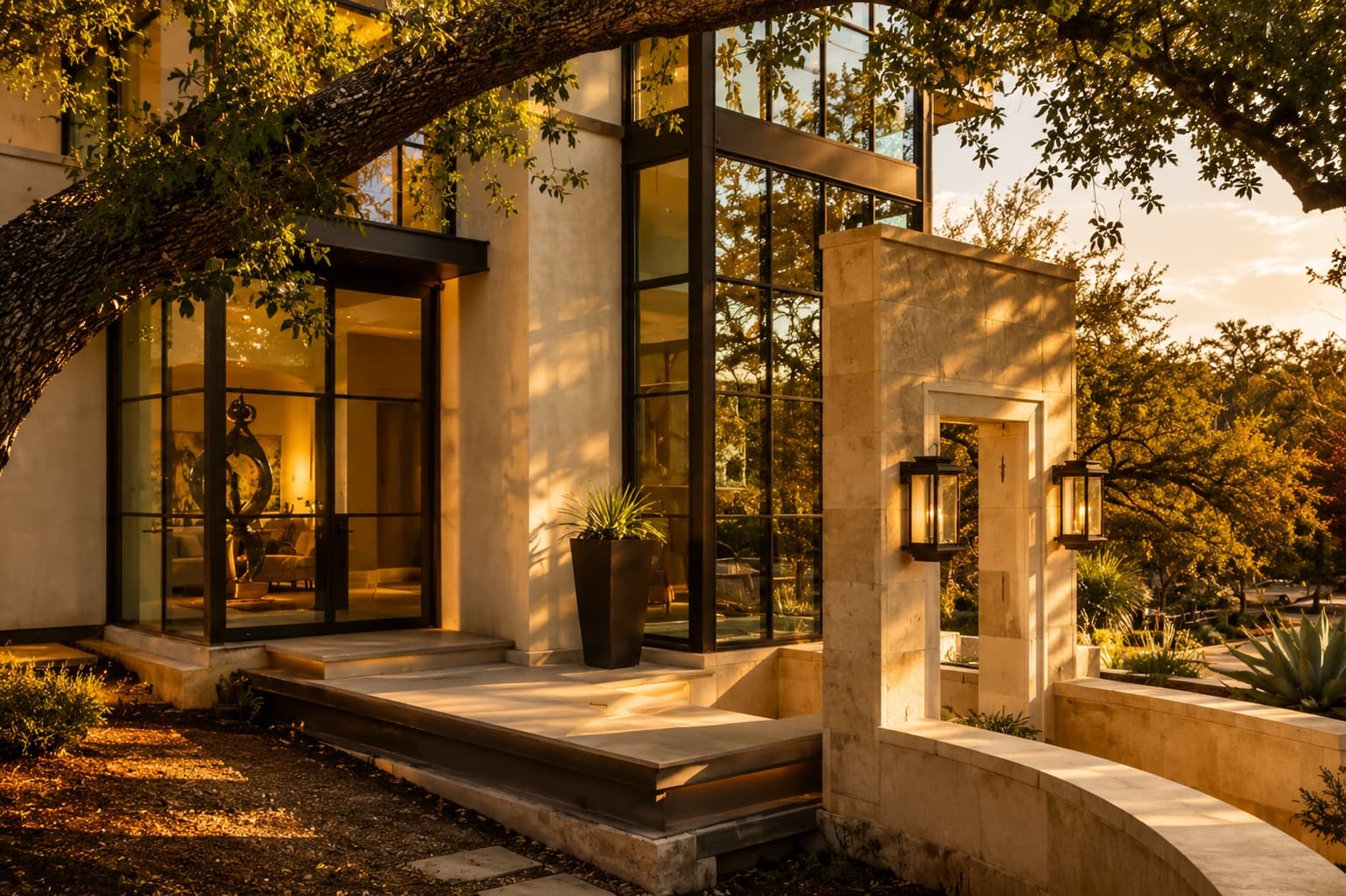
Tarrytown reads as a catalog of twentieth-century residential styles, much of it built between the 1940s and 1960s with homes dating to the 1920s. Larger lots than neighboring Clarksville sustain an active teardown-and-rebuild market, where buyers rebuild around the mature trees rather than clear them.
- Tudor Revival
- Colonial Revival
- Spanish Colonial Revival
- Craftsman bungalow
- Mid-Century Modern
- Contemporary new build
Coveted streets include Scenic Drive (lakefront), Bridle Path, Pecos, Mayfair, and Tanglewood, and the Exposition corridor.
The architecture guide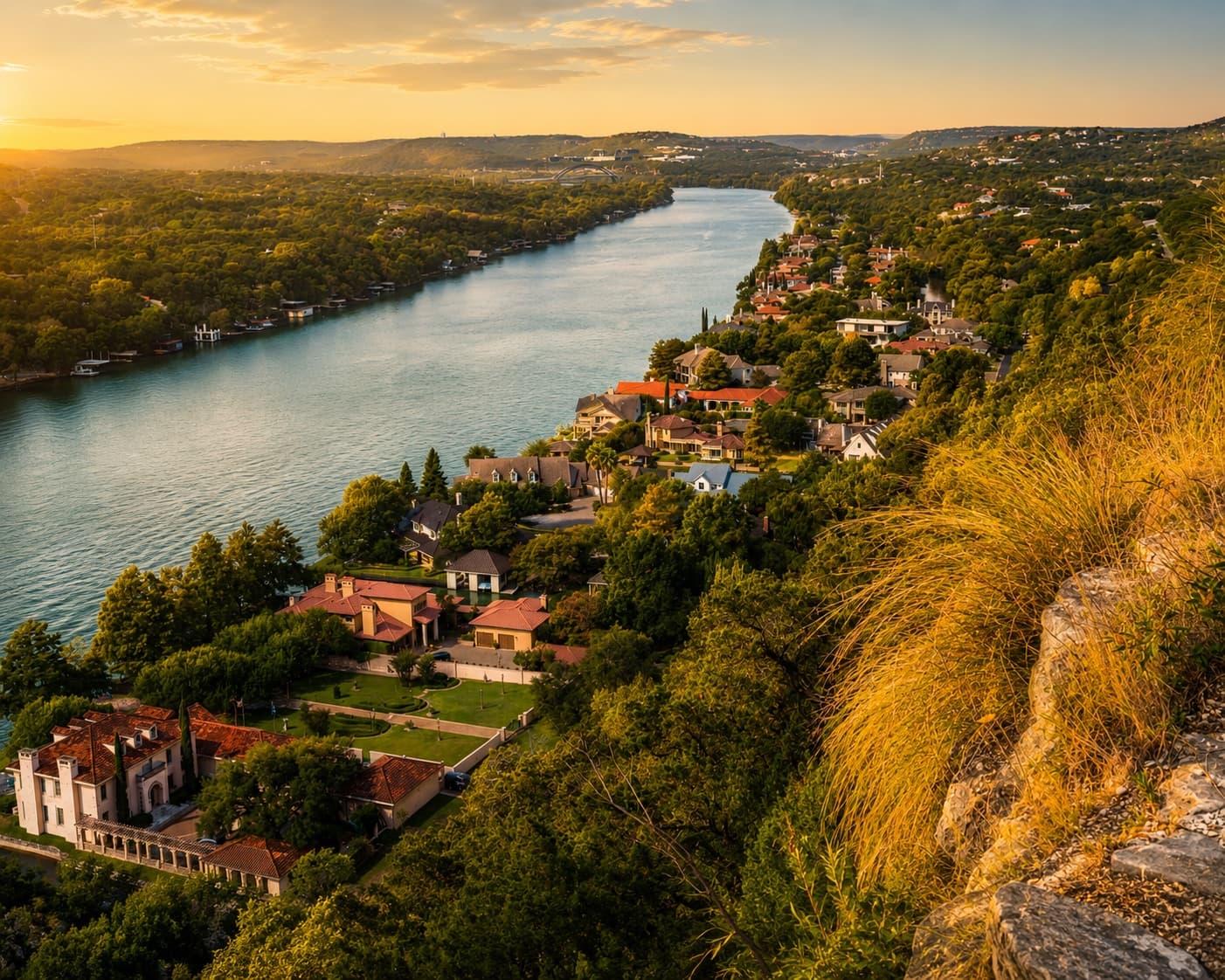
The defining asset
Lake Austin and the waterfront
The western edge of Tarrytown is its luxury anchor. Lake Austin is a constant-level lake, held steady by the dams above and below, so boating and docks never take a season off. Unlike drought-prone Lake Travis, the water is always there. The shoreline is finite, and that scarcity sets the ceiling for West Austin pricing.
The finite Lake Austin shoreline, on a lake that does not drop, is the single most durable explanation for why Tarrytown values resist the broader market’s volatility.
Parks and recreation
A rare concentration of green
Lions Municipal Golf Course, “Muny”
Established in 1924 as the first public course in Austin, Muny quietly became the first desegregated municipal golf course in the South in late 1950 (per the National Register nomination, Texas Historical Commission, NRHP #16000354). It was added to the National Register in 2016 and named one of America’s 11 Most Endangered Historic Places. Its long-term future is undetermined as the University of Texas and the City of Austin continue to negotiate over the land.
Mayfield Park and Nature Preserve
Twenty-one acres of koi ponds, cottage gardens, and resident peacocks, with trails toward Lake Austin.
Deep Eddy Pool
The oldest swimming pool in Texas, spring-fed and built in 1915 to 1916, just south of the neighborhood.
Laguna Gloria
Clara Driscoll's 1916 lakeside villa, now part of The Contemporary Austin, with a sculpture park on the water.
Red Bud Isle
A small island park below Tom Miller Dam, a favorite for off-leash dogs and kayak launching.
Reed Park and Walsh Boat Landing
A neighborhood park with a pool and courts, and a public ramp for direct Lake Austin access.
Mount Bonnell
One of the highest points in Austin, a short drive north, with panoramic views over Lake Austin.
Dining and shopping
Everyday needs are met along Exposition Boulevard, anchored by the Tarrytown Shopping Center and Casis Village, keeping the Tarrytown Pharmacy, cafes, and grocers within a short walk. On the lake, the social calendar runs through Hula Hut, Abel’s on the Lake, and Mozart’s Coffee. See the full dining guide.
Austin ISD
The school that anchors demand
Most of Tarrytown is zoned to Casis Elementary, which ranks in the top 5 percent of Texas schools and feeds O. Henry Middle School and Austin High. Families move here specifically for the zone, a demand that has held for decades. Attendance boundaries can change, so confirm the zone for a specific address with Austin ISD.
Elementary
Casis
Top 5% in Texas
Middle
O. Henry
Niche A-
High
Austin High
On the lake
Scarcity-backed stability
The market, in brief
There is no new land to make, the school assignment is fixed, and the waterfront is finite, so prices have a structural floor.
As of June 1, 2026, verify before relying on them. The full market report.
Who lives in Tarrytown
Established, and staying
Tarrytown is home to established wealth, executives, entrepreneurs, and professionals, alongside families who move here for Casis and lake-lifestyle buyers drawn by the water. The draws are consistent: prestige, a mature canopy, walkability, proximity to downtown and UT, distinctive architecture, and values that hold because supply is constrained.
Tarrytown questions, answered
The essentials
- Where is Tarrytown in Austin, Texas?
- Tarrytown is a neighborhood in West Austin, Texas, in ZIP code 78703 and MLS area 1B. It sits west of MoPac (Loop 1) along Lake Austin (the Colorado River), bounded by West 35th Street on the north and Lake Austin Boulevard and Enfield Road on the south, a few minutes from downtown Austin and the University of Texas.
- Why is Tarrytown so desirable?
- Tarrytown combines prestige, a mature tree canopy, distinctive architecture, walkability to the Exposition corridor, direct Lake Austin access on some streets, and the top-rated Casis Elementary School. Its supply is constrained and its values are durable, which is why it has remained one of Austin's most established luxury addresses since its first subdivision opened in 1934.
- How much do homes cost in Tarrytown?
- Over the trailing year in mid-2026, the median sale price in Tarrytown ran roughly $1.5 million to $1.65 million neighborhood-wide (Redfin and Homes.com). Prices range from updated homes near the low millions to Lake Austin waterfront estates between roughly $8 million and $15 million and higher. Verify current figures on the Tarrytown market report.
- What school is Tarrytown zoned to?
- Most of Tarrytown is zoned to Casis Elementary School (2710 Exposition Boulevard) in Austin ISD, which ranks in the top 5% of Texas schools. The feeder pattern continues to O. Henry Middle School and Austin High School. Attendance boundaries can change, so confirm the zone for a specific address with Austin ISD.
- What kinds of homes are in Tarrytown?
- Tarrytown's architecture includes Tudor Revival, Colonial Revival, Spanish Colonial Revival, Craftsman, and mid-century modern homes, much of it built between the 1920s and 1960s, alongside contemporary luxury new construction. Lots are generally larger than in adjacent Clarksville, and there is active teardown-and-rebuild around the mature live oaks.
- Does Tarrytown have Lake Austin waterfront homes?
- Yes. Streets such as Scenic Drive front Lake Austin, a constant-level lake that allows year-round boating. The shoreline is finite, roughly 22 miles in total, which makes direct waterfront the rarest and most valuable address in the neighborhood, with prime estates reaching eight figures.
Related