The Tarrytown Journal
Tarrytown Architecture: A Guide to the Homes and Styles
Tarrytown reads like a living catalog of twentieth-century American architecture. Storybook Tudors sit near serene Colonial Revivals, stucco Mediterranean homes turn inward to shaded courtyards, and glass-walled mid-century houses share the canopy with brand-new contemporary builds. Here is how to recognize each style, and what that mix means for buyers and sellers.
Tarrytown developed largely from the 1930s through the 1960s. Its first subdivision phase opened on November 4, 1934, and a handful of homes predate it from the 1920s. That timeline explains the neighborhood's defining feature: a rich, layered mix of period-revival and mid-century architecture, with almost no single style dominating a given block. Today those older homes share the streets with contemporary luxury new construction, built through active teardown-and-rebuild on the neighborhood's larger lots and around its mature live oaks. Here is how to read what you are looking at.
Tudor Revival
Tudor Revival is the style most people picture when they imagine old Tarrytown, and it defines storybook streets like Bridle Path. Drawn from late-medieval English precedent, these homes read as picturesque and asymmetrical. Look for steeply pitched, front-facing gables, often stacked at staggered heights, and decorative half-timbering set into stucco or brick on the upper walls. Windows tend to be tall and narrow, grouped in bands, and the best examples still carry their original leaded or diamond-paned glass. A prominent, elaborately detailed brick or stone chimney is almost a signature, frequently placed on the front facade rather than tucked at the side. Rooflines are complex, doorways are often arched, and the overall effect is intimate and romantic rather than grand.
Colonial Revival
Colonial Revival sits at the opposite temperament: formal, symmetrical, and calm. Where Tudor homes are picturesque, these are ordered. The facade is balanced around a centered front door, with windows arranged in even ranks on either side and matched above. The entry is the focal point, often framed by a columned portico, a pediment, or sidelights and a fanlight. Double-hung windows with multiple panes are common, usually flanked by working or decorative shutters, and red brick is the dominant material, sometimes painted. Roofs are typically side-gabled or hipped with a moderate pitch. The style reads as timeless and understated, which is part of why so many Tarrytown examples have been carefully preserved and updated rather than replaced.
Spanish Colonial Revival and Mediterranean
Spanish Colonial Revival and the broader Mediterranean idiom bring a warmer, more Southwestern note to the neighborhood, well suited to the Central Texas climate. These homes are finished in smooth stucco, most often white or a soft earth tone, and capped with low-pitched roofs of red clay barrel tile. Arches are the recurring motif, appearing over entries, windows, and shaded loggias. Many plans turn inward around a private courtyard or a walled garden, trading a formal street presence for outdoor living space. Details to look for include wrought-iron accents, carved or heavy wood doors, decorative tilework, and small ornamental windows. The result is a home that feels cool, textured, and genuinely connected to the outdoors.
Craftsman and bungalow
Tarrytown's oldest homes include Craftsman bungalows, several of them from the 1920s, predating the main waves of development. The Craftsman style celebrates handwork and honest materials over applied ornament. These houses are usually one or one-and-a-half stories, with low-pitched, gently overhanging roofs and wide eaves. The defining feature is a deep, welcoming front porch, typically carried on tapered columns that rest on masonry piers. Under the eaves you will often see exposed rafter tails and decorative beams, and windows are frequently grouped with multi-pane upper sashes over a single lower pane. Modest in scale but rich in detail, these bungalows offer character on a more human footprint than the neighborhood's larger estates.
Mid-Century Modern
By the 1950s and 1960s, as Tarrytown filled in, mid-century modern homes arrived and brought a very different philosophy. Instead of looking back to European or Colonial precedent, these houses look outward to the site. Expect clean horizontal lines, low or flat rooflines, and simple, unornamented forms. Walls of glass, sliding doors, and clerestory windows dissolve the boundary between inside and out, framing the live oaks and drawing in light. Open floor plans encourage indoor-outdoor flow onto patios and terraces, which suits the Austin climate. Materials tend to be plainspoken: brick, stained wood, and stone. Well-kept examples are increasingly prized by buyers who specifically want authentic period modernism.
Contemporary new construction
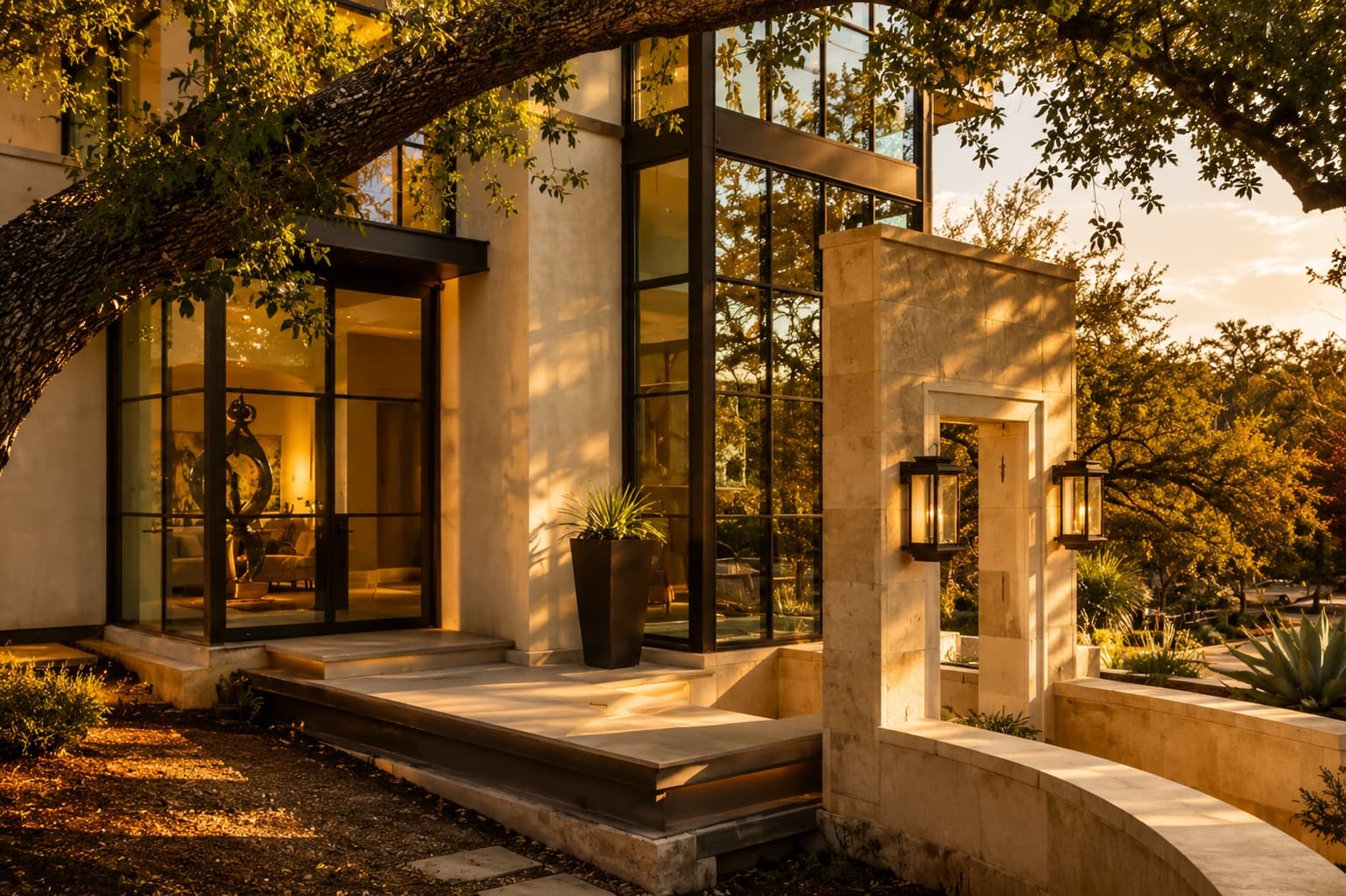
The newest layer of Tarrytown's architecture is contemporary luxury new construction, delivered through active teardown-and-rebuild. Because the neighborhood's lots are larger than those in many adjacent areas, and because they sit under mature live oaks, they are attractive sites for ground-up homes. These houses favor bold, rectilinear massing, generous glazing, and a restrained, high-end material palette: steel and glass, board-formed concrete, standing-seam metal, and warm accents of white oak and natural stone. Interiors are open and light-filled, with volume, wide-plank floors, and seamless connections to outdoor living. Good architects site these homes to preserve significant trees, so the finished product blends contemporary form with the canopy that defines the street.
How architecture affects value in Tarrytown
Architecture and condition interact to shape value in Tarrytown, and it helps to separate three broad cases. An original home with intact period character can command a premium from buyers who specifically want a preserved Tudor or Colonial Revival, but it may also be priced closer to lot value if it needs comprehensive work. A thoughtfully updated older home, one that keeps its character while modernizing systems, kitchens, and baths, often draws the deepest buyer pool. A brand-new contemporary build sits at the top of the price range on a finished basis, reflecting current construction costs. Underpinning all three is land: on the larger lots, the parcel itself carries much of the value, and preserving the mature live oaks can meaningfully lift what a site is worth. Every property is different, so confirm the specifics of a given home before drawing conclusions.
Whether you are drawn to a storybook Tudor, a serene Colonial Revival, or a glass-and-oak new build, Tarrytown offers real range within one established neighborhood. To see how these styles trade today, browse current Tarrytown homes for sale and the Tarrytown luxury homes collection, explore Tarrytown new construction homes, and read the broader Tarrytown neighborhood guide for history and boundaries. For a sense of where the finest examples cluster, see our guide to the best streets in Tarrytown. When you are ready to weigh a specific home, that is a conversation a local specialist can help you have.
Good to know
Tarrytown questions, answered
- What architectural styles are in Tarrytown?
- Tarrytown's housing stock is a rich mix. You will find Tudor Revival, Colonial Revival, and Spanish Colonial Revival (Mediterranean) homes, along with earlier Craftsman bungalows, 1950s and 1960s mid-century modern houses, and contemporary luxury new construction. That variety comes from the neighborhood filling in gradually across several decades, so the style can change noticeably from one block to the next.
- How old are Tarrytown homes?
- Most of Tarrytown developed from the 1930s through the 1960s. Its first subdivision phase opened on November 4, 1934, and a handful of homes predate that from the 1920s. Because of active teardown-and-rebuild, many original houses now sit beside brand-new contemporary construction, so ages vary widely from one property to the next. Always confirm a specific home's year built and permit history rather than assuming from the street.
- Can you build a modern home in Tarrytown?
- Yes. Contemporary new construction is one of the most active parts of the market, delivered largely through teardown-and-rebuild on the neighborhood's larger lots. Any new build is still subject to City of Austin zoning, permitting, setback, and tree-protection rules, and some pockets carry additional considerations. Work with a builder and design team who know the local process, and verify the rules that apply to a specific lot before you plan.
- What is the most recognizable style in Tarrytown?
- The Tudor Revival is the style most people picture when they imagine old Tarrytown, with its steep gables, half-timbering, leaded glass, and prominent chimneys. It defines storybook streets like Bridle Path. That said, Colonial Revival and Spanish Colonial Revival homes are common too, and no single style dominates the whole neighborhood.
- Does an original older home or a new build hold value better in Tarrytown?
- It depends on the property. A well-preserved period home can draw buyers who specifically want character, a thoughtfully updated older home often attracts the widest pool, and a new contemporary build sits at the top of the price range on a finished basis. Underpinning all of them is the land, since Tarrytown's larger lots carry much of the value. This is general information, not a valuation of any specific home.
Related
Continue through Tarrytown
Work with Luke
Speak with a Tarrytown specialist
Whether you are years from a move or ready this season, Luke Allen answers Tarrytown questions personally: which streets fit your life, what Lake Austin frontage or Casis zoning is really worth, and when the right home is coming to market.

Luke Allen
Licensed Texas REALTOR, TREC #788149
Austin Marketing + Development Group